
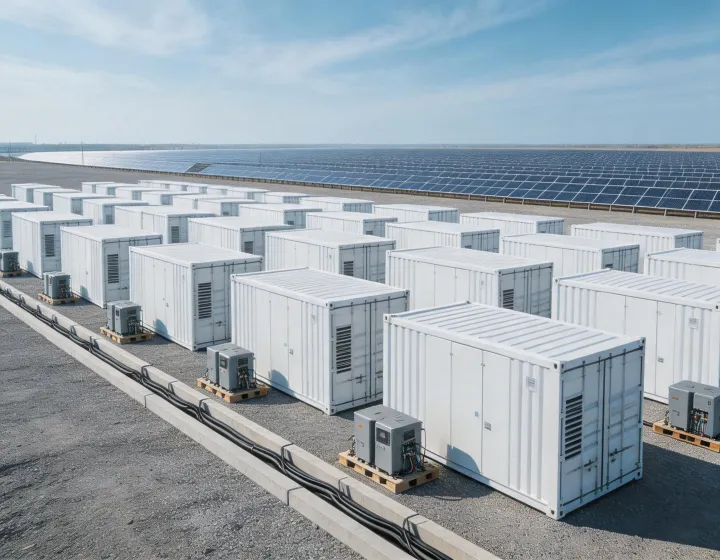
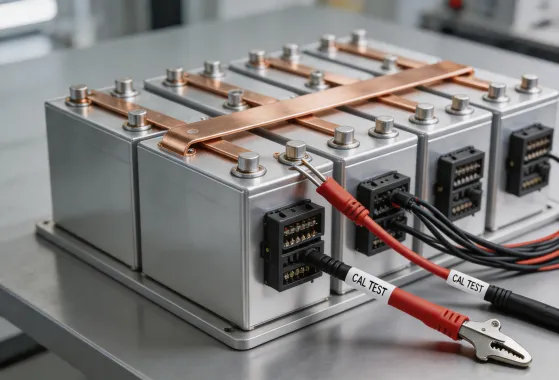
Documented cell-to-rack traceability
Cell grading, module assembly records, insulation checks, and rack commissioning references are organized for procurement review instead of being scattered across late-stage submittals.
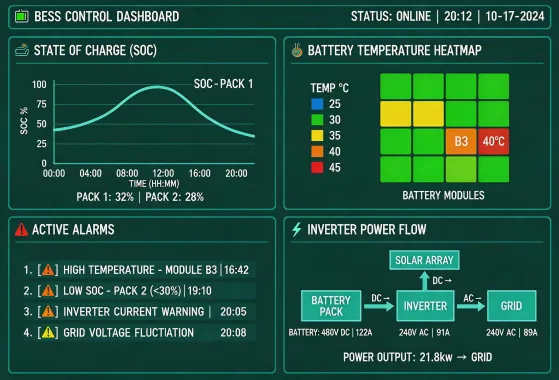
Batteries & Energy Storage Systems
Specify cell, module, rack, and container-level energy storage with documentation that helps EPC engineers validate cycle life, safety, thermal behavior, and grid interface requirements before procurement.
Specification comparison
Use these reference bands to discuss battery architecture, usable capacity, thermal management, and warranty assumptions with a project engineering team.
| Parameter | Commercial ESS | Utility BESS |
|---|---|---|
| Usable capacity | 100 kWh-2 MWh blocks | 2-20 MWh containerized blocks |
| Chemistry focus | LFP or NMC by duty cycle | LFP priority for long-duration dispatch |
| Cycle life target | ≥6,000 cycles @ 90% DoD | ≥8,000 cycles with controlled C-rate |
| Round-trip efficiency | Up to 95% system level | Modeled with PCS and HVAC losses |
| Safety package | BMS, enclosure sensing, disconnects | Thermal analysis, fire detection, EMS interface |
| Design support | Single-line review and commissioning plan | Grid interconnect data, augmentation planning |
Engineering features
Cell grading, module assembly records, insulation checks, and rack commissioning references are organized for procurement review instead of being scattered across late-stage submittals.
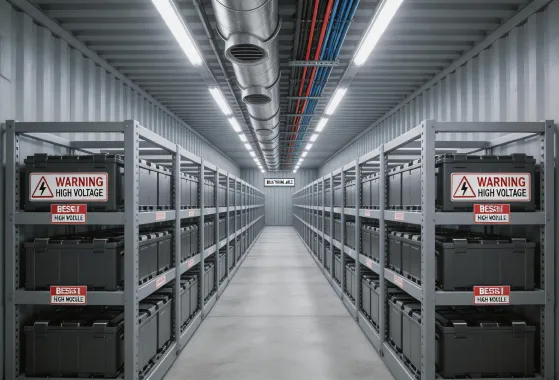
State of charge, state of health, rack temperature, alarm priority, and dispatch mode data can be prepared for SCADA, EMS, and portfolio analytics workflows.
Project packages can include ventilation assumptions, heat rejection inputs, isolation concepts, emergency response notes, and commissioning checkpoints for local authority review.
FAQ
Separate nominal capacity from usable capacity, then define operating SOC windows, C-rate, ambient temperature, and planned augmentation assumptions.
Yes, storage blocks can be evaluated with PV inverters, PCS equipment, and EMS dispatch logic when interconnection and metering points are clearly defined.
LFP is commonly prioritized for stationary applications because thermal runaway onset is significantly higher than NMC, while NMC may fit density-driven applications.
Transport packages typically include UN 38.3 references, battery handling notes, safety data sheets, and region-specific logistics documentation.
Warranty discussion should reference cycle count, operating temperature, depth of discharge, EoL capacity, and approved maintenance conditions.
Remote alarm planning can include severity levels, escalation windows, API data mapping, firmware records, and response responsibility matrices.
Documentation